För en vecka sen fick jag ett mejl från SA5IKN/Max i Uppsala. Han är framför allt intresserad av EME (Earth Moon Earth) och har uppnått fantastiska resultat, bland annat några världs- och Sverigepremiärer.
Här nere följer hans e-post på engelska. Glöm inte att besöka hans webbplats (https://dxer.site/) och tack Max för din artikel!
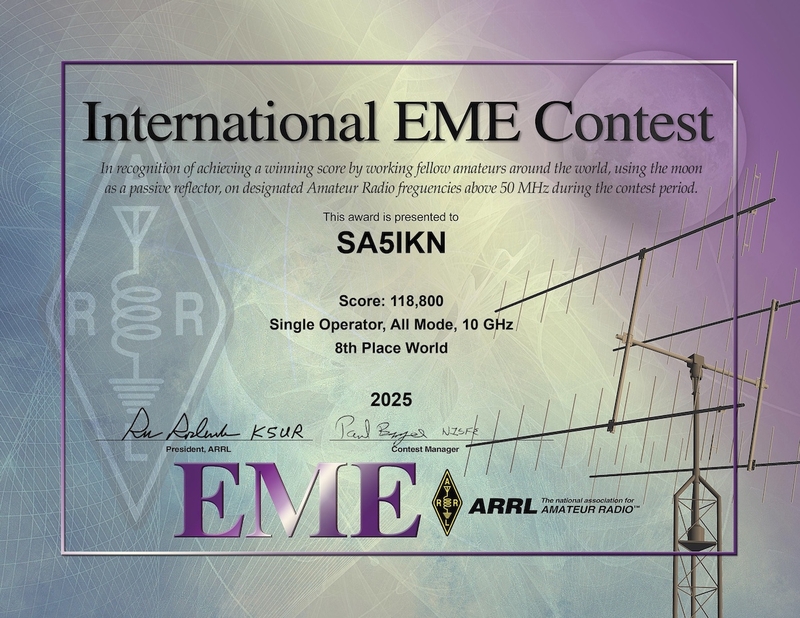
As I write this email, I am glancing over the final results of the 2025 ARRL International EME Contest, which were published yesterday. In that contest, I placed 8th on 10 GHz. While this may not seem remarkable on the face of it, it represents the highest score achieved from Sweden on 10 GHz to date.
More importantly, this result was achieved using a fully portable, battery-powered system, consisting of a small 0.9m dish and 27W at the feed. Based on the published yearly results (https://contests.arrl.org), this is the smallest dish ever to reach the top rankings in the ARRL EME Contest.
I operated in a very relaxed manner, for only 4 + 3.5 hours out of the 48 hours available across the four moon passes of the two contest legs. This was far from the structured approach I used during my more serious CW contesting on HF a decade or two ago. I definitely missed several easy multipliers, and all of EU–AS and EU–OC windows.
As you know, EME is a highly technical frontier of amateur radio. Success in EME does not come from unexpected propagation openings, but rather from careful system design, analytical work or modeling, and measurement.
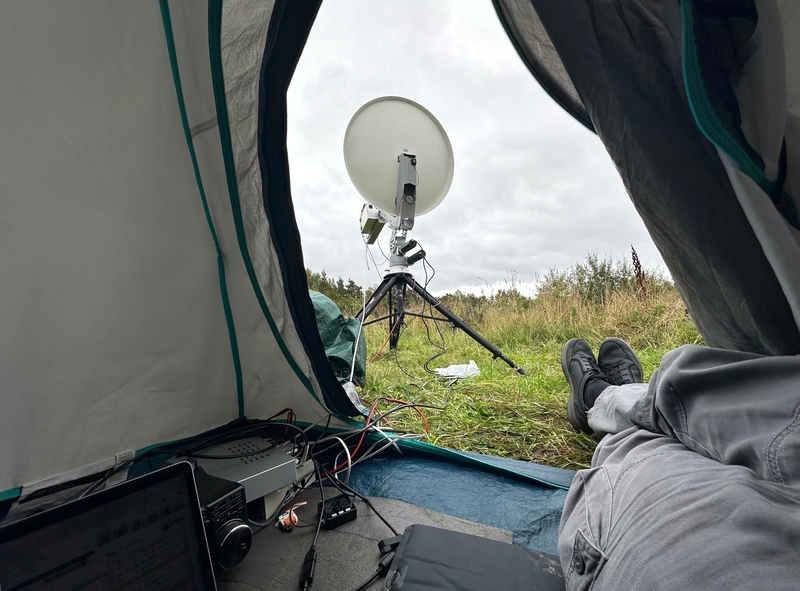
After years of EME activity on lower bands, I set myself the goal in 2024 of designing the world’s smallest 10 GHz station capable of working ”its twin”. This goal was realized in August 2025, when I completed a QSO with Bruno I6YPK, who was operating a 1 m dish and 25 W – a dish only marginally larger than mine but similar in terms of EIRP – effectively ”a twin system” (https://groups.io/g/Moon-Net/topic/114782976).
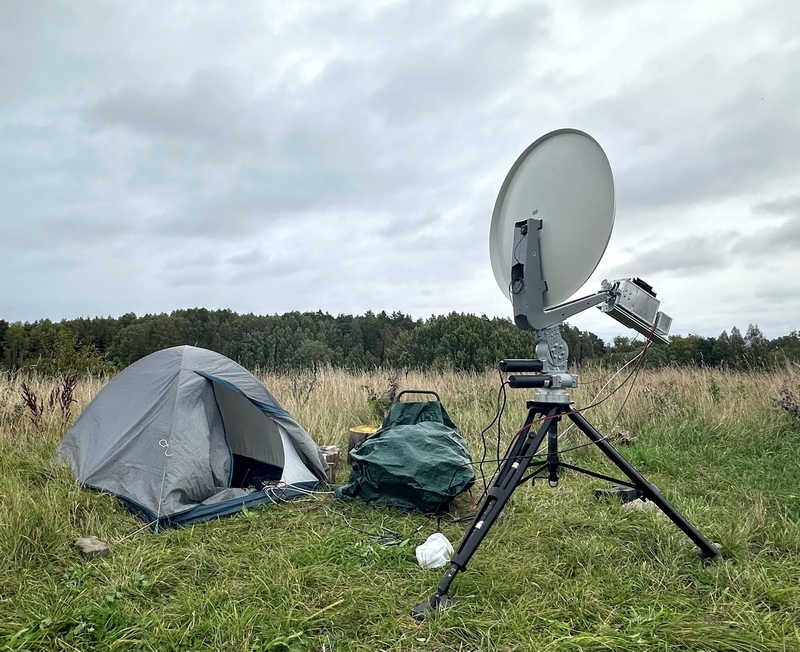
Since then, I have made over 200 QSOs on 10 GHz EME, often generating pileups, and have added a number of Sweden’s first contacted DXCCs (https://www.ssa.se/vushf/listor/forsta-kontakt/?eme=1&band_id=18) while operating both portable and from home. I designed my EME system to be also suitable for terrestrial use and regularly participate in NAC Micro contests.
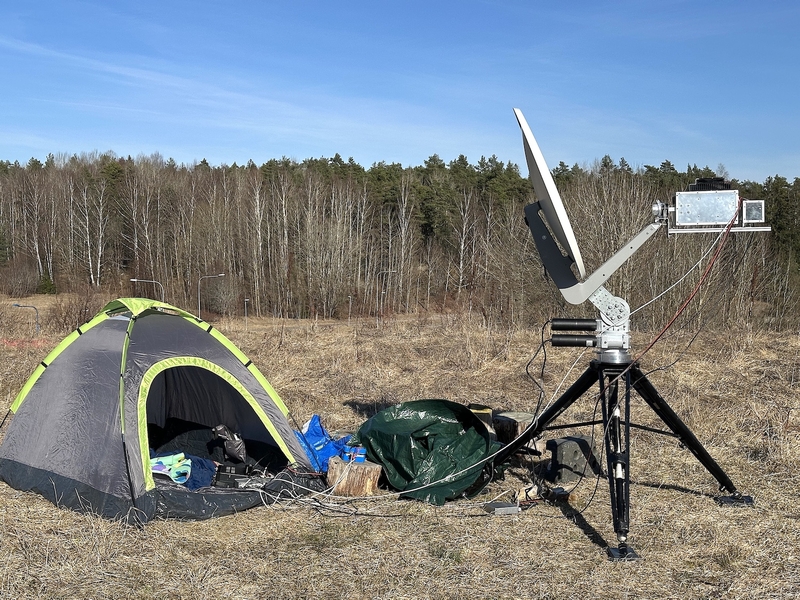
I hope that this example may inspire others to design and build high-performance EME stations, where theory and practical results go hand in hand.
If this sounds of interest, I would be happy to provide more details in whatever aspect might be of interest to the reader. I attach a few relevant images.
73,
Max SA5IKN https://dxer.site/